

“Recovery. Sexual Life”
“Recovery. Sexual Life”
A free educational programme for specialists working with injured military personnel, aimed at restoring sexual life as an essential part of comprehensive rehabilitation.
Who is it for?
The programme invites Ukrainian psychologists, psychotherapists, psychiatrists, physicians in physical and rehabilitation medicine, physical therapists, occupational therapists, as well as wounded military personnel who have completed rehabilitation (including sexual rehabilitation).
Format
The programme lasts three months.
Classes are held twice a week and include both lectures and practical sessions, delivered online.
After completing the educational component, the programme includes:
- one individual mentoring session for specialists with supervisor Katherine Ellis;
- one individual session for veterans with a qualified CasuVac representative, following a “peer-to-peer” approach.
Trainers
Katherine Ellis (USA)
PhD, occupational therapist, certified sexuality counselor (Institute for Sexuality, Intimacy, and Occupational Therapy). She is the lead international expert, mentor, and supervisor of the programme. Author of certification programmes for occupational therapy specialists and numerous interdisciplinary trainings at national and international levels. She lectures for rehabilitation teams in Ukraine and is a co-editor of the textbook “Sexuality and Intimacy: An Occupational Therapy Perspective” and the sexuality workbook “Let’s Talk About It: Your Guide to Sex and Intimacy” for the U.S. Veterans Health Administration.
Ronit Aloni (Israel)
Psychotherapist and sexologist, member and former head of the Israeli Society of Sexology and the Israeli Association for Family and Couple Therapy. Graduate of the psychosexual therapy programme at New York University, where her thesis focused on surrogate partners affiliated with IPSA (International Professional Surrogates Association). She trained at the psychiatric clinic of NYU Hospital and the Rusk Rehabilitation Institute.
Rafi Heruti (Israel)
Professor of Rehabilitation Medicine, specialist in physical medicine and rehabilitation, sexologist. Member and former head (twice, 2011–2017) of the Israeli Society of Sexology. Founder of the Sexual Rehabilitation Service at Sheba Medical Center (Tel Hashomer). Since 2000, he has worked at Reuth Rehabilitation Hospital, where he serves as Head of the Rehabilitation Department.
Andriy Krasiukov (Canada)
MD, PhD, FRCPC, Professor of Medicine, Division of Physical Medicine and Rehabilitation. Head of the Department of Rehabilitation Medicine, Associate Director and Scientist at ICORD, Director of the Autonomic Nervous System Research Unit, clinician at GF Strong Rehabilitation Centre (University of British Columbia). Former President of the American Spinal Injury Association (ASIA).
Borys Vornik (Ukraine)
Leading sexologist of Ukraine, Doctor of Medical Sciences, Professor of the Department of Sexology and Medical Psychology. Honored Doctor of Ukraine, top-category sexopathologist. Member of the European Federation of Sexology and international expert in sexual and reproductive health.
Sviatoslava Fedorets (Ukraine)
Sexologist, psychologist, forensic expert. Specialises in sexual rehabilitation of military personnel, veterans, and civilians with disabilities.
Yuliia Yaroshenko (Ukraine)
Sexologist, Master of Public Health, founder of the S.E.X.prostir project — a science-based public talk conference, founder of Sensual Culture, a school for adult sexuality development, and author of the Telegram channel Sexual Culture.
Matt Fossey (United Kingdom)
FRSA, Professor of Public Services Research and Director of the Veterans and Families Institute (VFI), Co-Director of the Centre for Military Women’s Research (CMWR), social science research advisor at Anglia Ruskin University Medical School.
Thomas Kirsi (United Kingdom)
Postgraduate researcher at the Veterans and Families Institute (VFI), Anglia Ruskin University, Chelmsford. Has worked in the veterans’ sector for over ten years, including at the leading UK charity for veterans’ mental health, Combat Stress.
Hilary Ingham (United Kingdom)
Associate Professor of Social Sciences and Deputy Director of the Veterans and Families Institute (VFI), Anglia Ruskin University. Leads research on how veterans and their families live with limb loss or loss of limb function.
Programme Topics
- Introduction to sexuality and relationships for wounded military personnel
- Assessment of common sexual difficulties among wounded service members
- Guided self-reflection on sexual values, beliefs, attitudes, and biases
- Desire and arousal
- Interventions for common sexual difficulties
- Neurodiversity / traumatic brain injury / PTSD
- Dating and new relationships
- Sensory and sex-device laboratory
- Sexual fantasies and dreams as support for intimacy in couples where one or both partners have physical limitations
- Working with sexuality in wartime conditions: core principles for working with Ukrainian sexuality
- Gentle adaptation and caring for loved ones in new relationship dynamics
- Discussing pain as a barrier to a fulfilling sexual life
- Fundamentals of medical sexology
- Pathways to recovery and sexual health after spinal cord injury (SCI)
What specialists gain from the programme
- Understanding of working with sexuality and intimate relationships during wartime and with people affected by combat-related trauma and disability;
- Practical intervention examples for working with different types of disabilities;
- Skills for recognising and working through personal stereotypes and beliefs about sexuality;
- Exercises, techniques, and materials for working with people with disabilities, particularly military personnel.
Certification
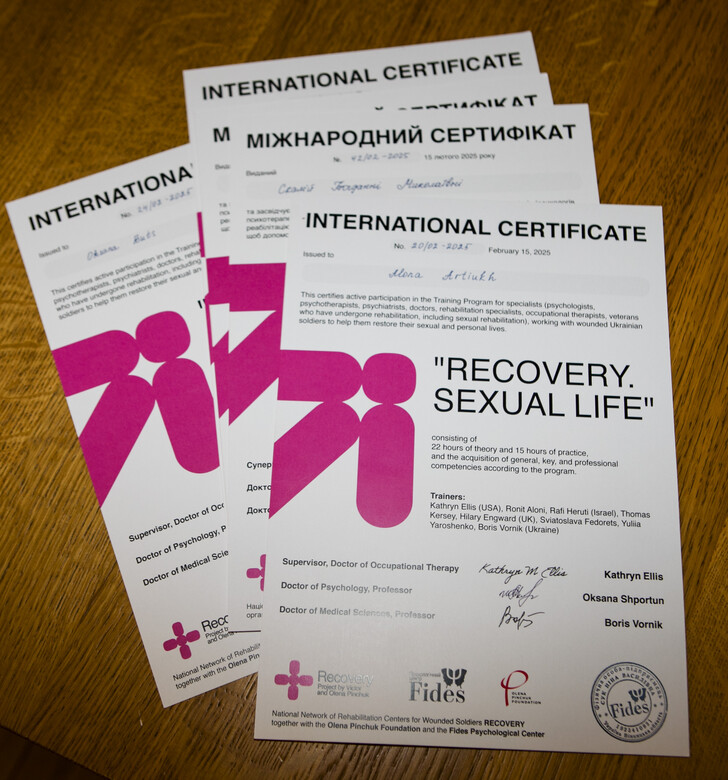
Graduates receive a certificate confirming successful completion of the programme, which includes 22 hours of theory and 15 hours of practice.
Programme in numbers
- Programme developed by 10 trainers
- 60 specialists trained
- Three cohorts completed