


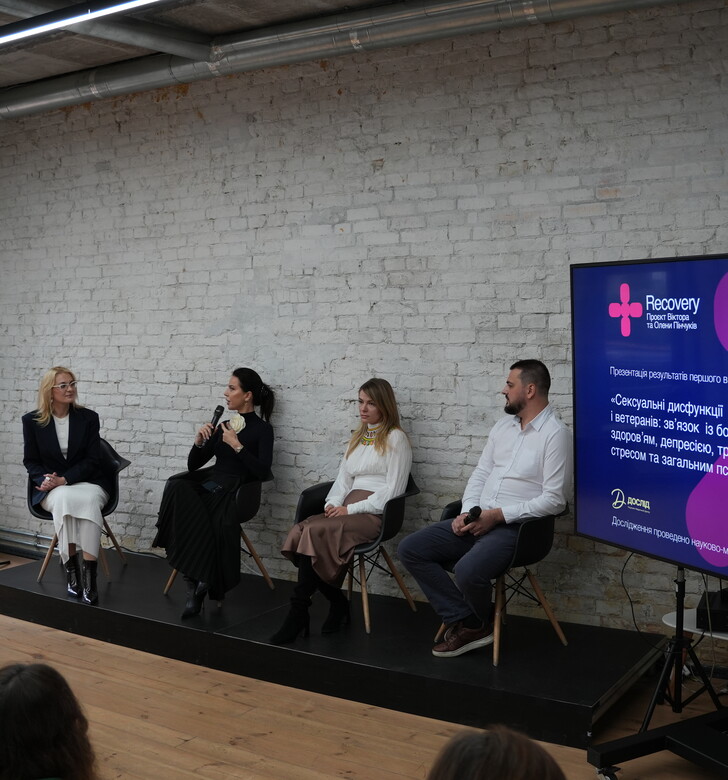
Commissioned by the “Recovery. Sexual Life” programme, implemented as part of the national RECOVERY network of rehabilitation centres, Ukraine’s first population-based study of sexual health among military personnel involved 464 Ukrainian service members. The findings show that sexual health is influenced not only by physical condition, combat-related injuries or PTSD, but also, to a significant extent, by the quality of intimate relationships.
Sexual health is an important component of a person’s physical and psychological well-being. However, in the context of military service and rehabilitation, it often receives less attention than injuries, PTSD or depression. At the same time, combat experience, prolonged stress, physical injuries, medication use and psychological difficulties can all affect service members’ sexual lives.
At the initiative of the “Recovery. Sexual Life” programme, the “Doslid” Scientific and Medical Centre conducted Ukraine’s first population-based study of sexual health among Ukrainian military personnel, involving 464 participants. Researchers comprehensively assessed both the prevalence of sexual dysfunctions and their associations with combat experience, physical health, depression, anxiety, post-traumatic stress, medication use, overall psychological well-being and the quality of relationships with partners.
The key findings include:
1. One in four participants experienced significant erectile difficulties.
24.8% of participants reported significant erectile difficulties — approximately one in four. Particularly noteworthy was the association between erectile dysfunction and intimate relationships: the extent to which a person feels satisfied with their relationship and experiences closeness and mutual understanding with their partner is significantly associated with their sexual health.
Importantly, relationship quality proved more relevant to understanding sexual difficulties than marital status or simply having a partner. Specifically, each additional point on the scale measuring relationship difficulties was associated with an approximately 7% increase in the odds of erectile dysfunction.
2. The impact of medication on sexual health
Military personnel taking medication to lower blood pressure had approximately 2.2 times higher odds of experiencing erectile dysfunction than those who were not taking such medication.
At the same time, the study found no statistically significant association between erectile dysfunction and the use of antidepressants or painkillers.
3. Depression and anxiety: more severe symptoms are associated with higher odds of erectile dysfunction
The more pronounced the symptoms of depression and anxiety, the higher the odds of erectile dysfunction. Specifically, each additional point on the scales assessing these symptoms was associated with an approximately 10% increase in the odds of erectile dysfunction.
4. The relationship between PTSD and sexual health is more complex than it may seem
Interestingly, a diagnosis of PTSD or complex PTSD alone did not fully explain sexual difficulties. The relationship between complex trauma symptoms and sexual functioning proved more nuanced than the simple assumption that PTSD leads to sexual dysfunction. A person's overall psychological well-being and the quality of their intimate relationships appeared to play a more significant role.
Overall, the findings demonstrate that sexual health difficulties among Ukrainian military personnel are a real and widespread health concern. They cannot be reduced to physiological factors alone or explained solely by PTSD.
This is why support for military personnel experiencing sexual difficulties must be multidisciplinary. Depending on the underlying causes and individual needs, it may combine medical assessment, psychological support and, where appropriate, the involvement of a partner in therapy.
“This study is an important step towards advancing sexual rehabilitation in Ukraine. Its findings help us better understand the needs of military personnel and veterans, as well as the factors that affect their sexual health. This scientific evidence should complement the practical experience of Ukrainian specialists and help develop a comprehensive approach to military rehabilitation, in which sexual health is recognised as an integral part of overall well-being,” says Olha Serdiuk, Director of the Olena Pinchuk Foundation.
“We now have more than individual clinical observations — we have systematic data on the sexual health of 464 Ukrainian service members. Using internationally recognised assessment tools and advanced analytical methods, including machine learning and network analysis, we were able not only to assess the prevalence of sexual difficulties but also to gain a better understanding of their associations with mental health, intimate relationships and physical health factors. These findings provide a foundation for improving the clinical assessment of sexual health among military personnel, training specialists and conducting further research, including longitudinal studies,” says Dmytro Martsenkovskyi, Head of Research at the “Doslid” Scientific and Medical Centre.
Link to Key Findings: expected


If you find an error in the text, select it with the mouse and press Ctrl+Enter or this button